History
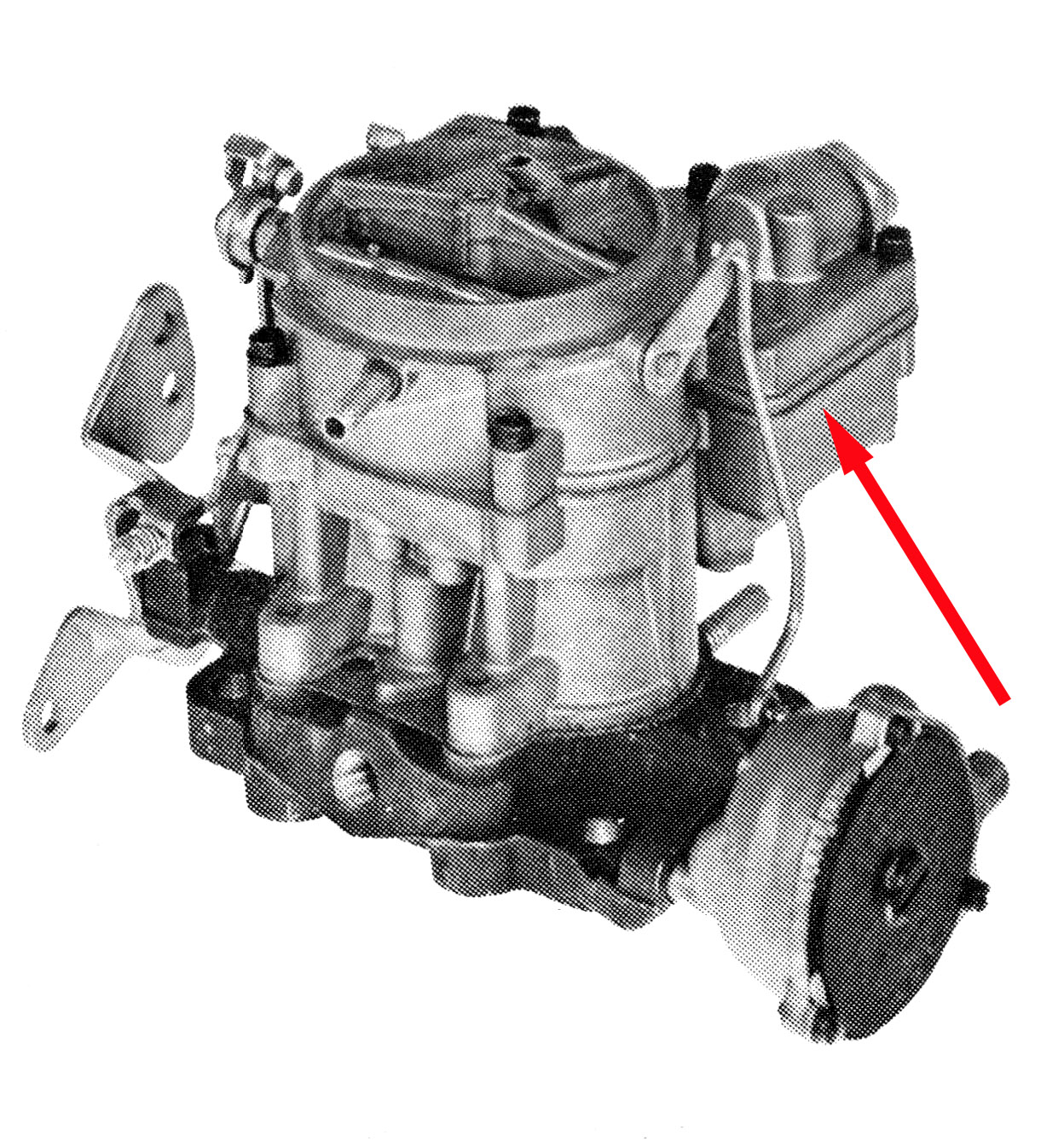
The Rochester 2 Jet is a two barrel downdraft carburetor that was produced from 1955 until the late 1980's. It was used at various times in every GM car and truck line, as well as marine engines and by other manufacturers such as Brockway truck, Checker Motors, Dodge and Plymouth (1971 318 engine), Kaiser and Jeep (Buick V6), Studebaker and White Motors.
2 jets were used in triple carb applications starting with the 1957 Oldsmobile J-2, and then Cadillac, Chevrolet, Oldsmobile and Pontiac Tripower setups. Today, there are many aftermarket manifolds for triple carbs on applications not originally used by the factory. Chevrolet never sold a factory small block Tripower, only the W-block Tripower (1958-1961 348 CID). Dual 2 Jet carbs were used on an OMC marine 4 cylinder.
Mercruiser made a Mercarb 2 barrel that looks very much like a Rochester 2 Jet, but uses mostly different internal parts.
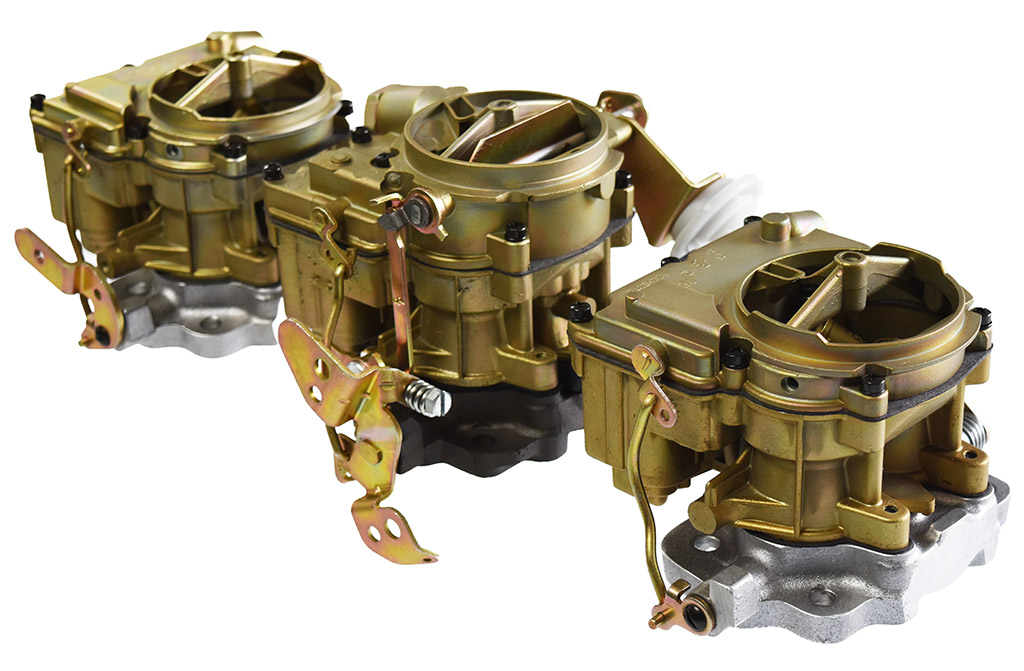
1966 Oldsmobile Tripower (reproduction carbs, some details not exact)
Design
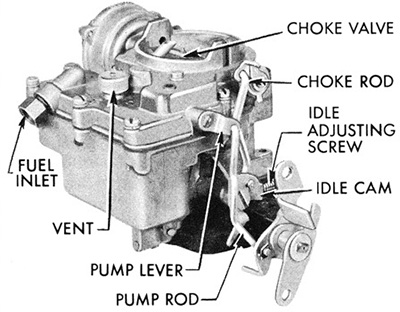
Typical Rochester 2-Jet carburetor, Buick model shown
The basic 2G design remained unchanged throughout its production run. The picture shows a typical 2GC carburetor (see Identification, below) which happens to be from an early 70's Buick. There are three parts to the carb, the throttle body at the bottom, which has the throttle shaft and throttle plates, the float bowl (middle part) and airhorn at the top. The choke valve, fuel inlet and vent are visible in the airhorn, and there is a pump rod on the side that connects to the accelerator pump inside. There's a lot more detail on the construction of these in our e-book manuals here.
The main internal features are a power valve in the bottom of the float bowl, and a side hung float with the needle and seat inverted in the airhorn. Most early power valves are the same as used in the 4G four barrel and the accelerator pump is a similar design.
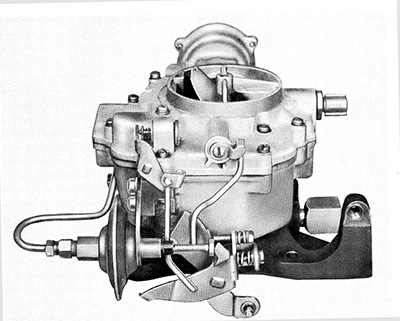
1956 Rocket 88 Special 2GC
In 1956, Rochester produced a special high performance 2GC carburetor for the Oldsmobile 88 (We have kit CK3452 for this one). The Special 2GC carburetor was more like the front half of a 4G than a 2G. Some of the design features resemble the earlier Rochester model BB carburetor.
Identification
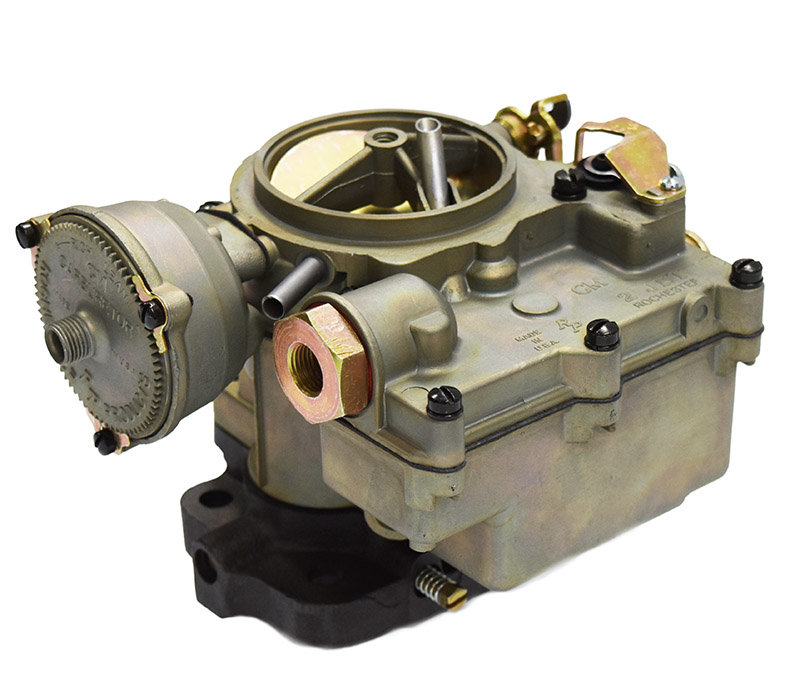
The 2GC is the automatic choke version with the choke coil mounted on the side of the carburetor. In early versions (1955 - late 1960's automotive) the choke thermostat assembly is attached to the airhorn (top part) of the carburetor. The choke coil is heated by hot air drawn through a tube connected to the intake manifold at the exhaust crossover or the exhaust manifold.
This layout was used in marine applications into the late 1980's. In many cases, the hot air choke was replaced with an electric choke coil.
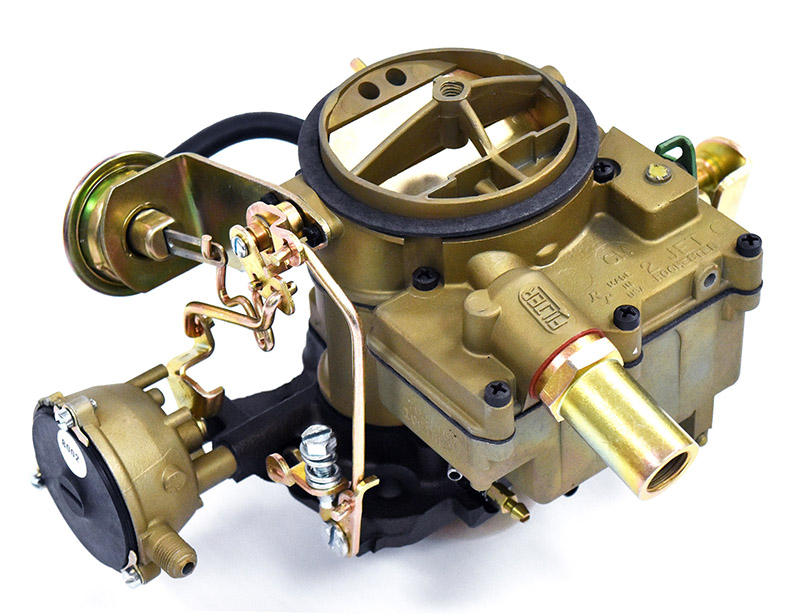
Starting in the mid-1960's the choke thermostat moved down to the throttle body. This arrangement was used until the last domestic automotive application in 1979.
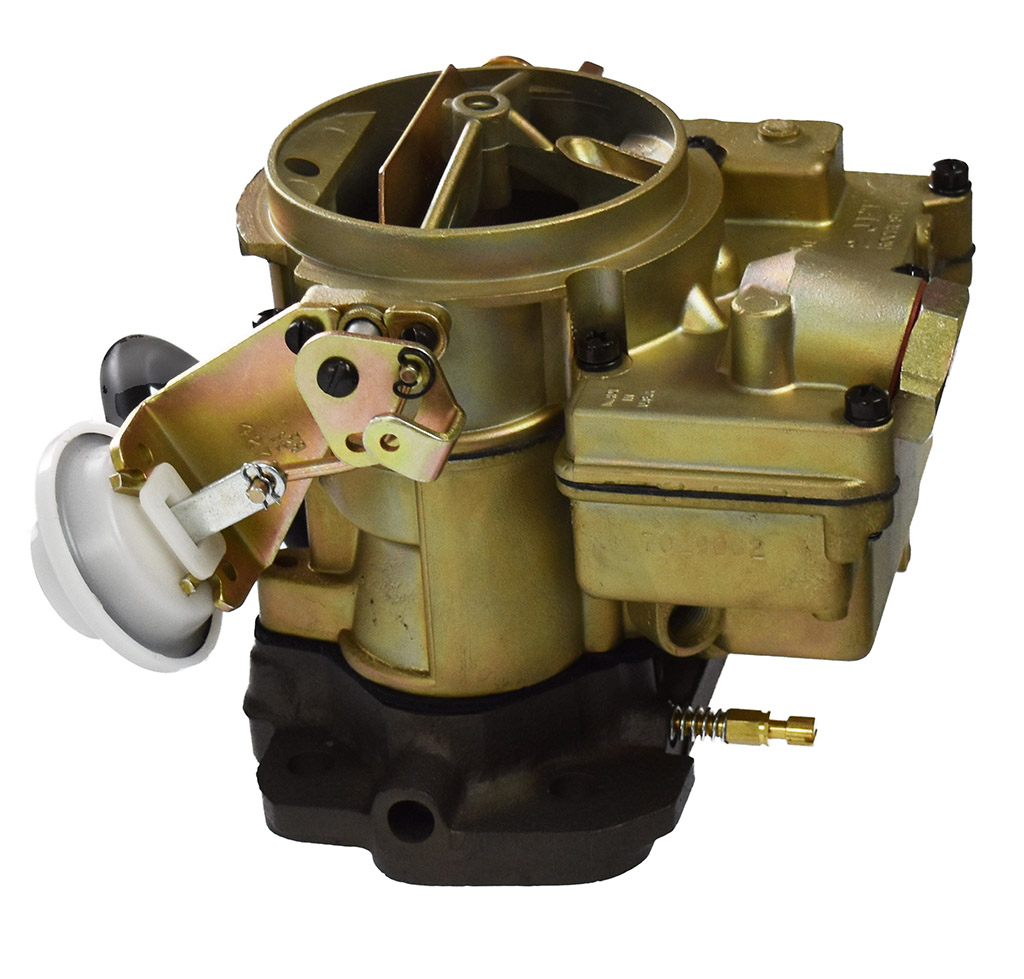
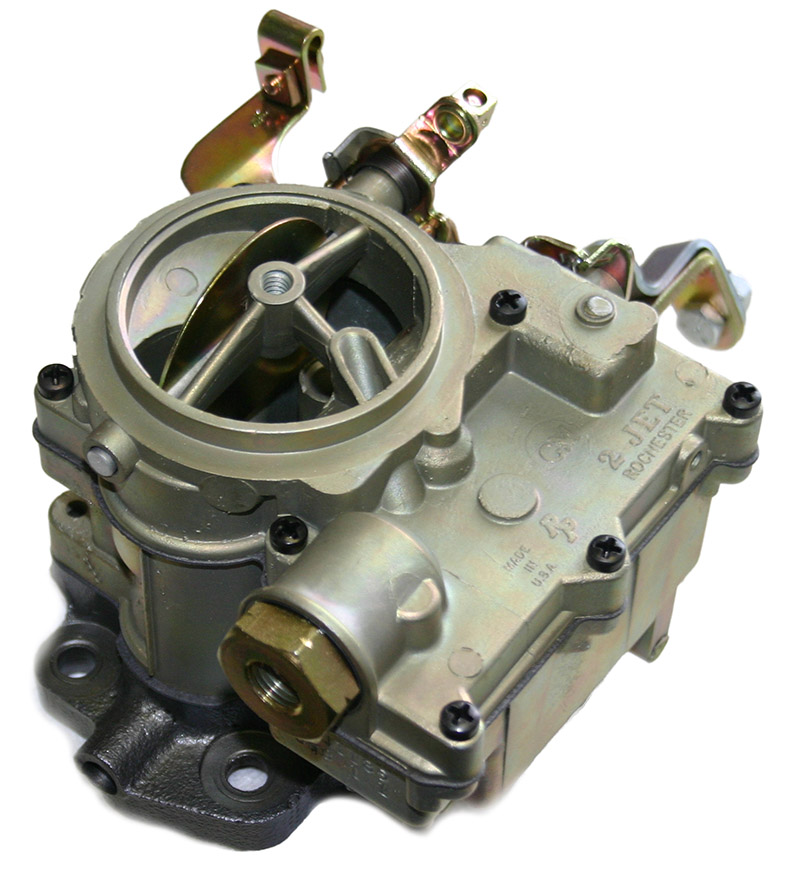
Manual choke carburetors (designated 2G) did not use a choke thermostat. These were found mainly on Chevrolet truck V-8 engines. The choke is manually operated by a cable leading to the dashboard in the cab.
Carburetor Size and CFM
Rochester 2G carburetors came in two basic groups: large and small flange. Small flange carburetors used an SAE 1-1/4" (nominal) flange with 1-7/8” X 3-1/4” mounting bolt centers. The large flange was an SAE 1-1/2" (nominal) flange with 2" X 3-11/16"mounting bolt centers.
Small 2 Jets were used until the early 70's, where they last appeared on 307 Chevy engines, though marine and industrial versions were produced into the 1980s. Large 2 Jets, with a bigger bolt pattern, started in the 1960s on BOP engines. By 1973, all automotive 2G's used the large flange.
Some classes of stock car racing need large Rochester 2 Jet carbs. These can be found on early 70's Chevy engines, including governed big-block motors in school buses. The school bus carbs require modification to the throttle body assembly to be usable.
| Flange | Throttle Bore | Venturi Size | CFM |
|---|---|---|---|
| small | 1-7/16 | 1-3/32 | 278 |
| large | 1-11/16 | 1-3/16 | 352 |
| large | 1-11/16 | 1-1/4 | 381 |
| large | 1-11/16 | 1-5/16 | 423 |
| large | 1-11/16 | 1-3/8 | 435 |
small = SAE 1-1/4", large = SAE 1-1/2", all measurements in inches. CFM is on 2 bbl rating scale. Divide by 1.4 to get approximate 4 bbl equivalent.
Carburetor Numbers
Before 1967 Rochester 2 Jet numbers were on a triangular tag attached to the top of the carburetor. Starting in 1968, the carburetor number is stamped on the driver's side of the float bowl. Rochester carburetor number locations